
Parallel Changes the World, Collaboration Achieves the Future.
Factories and distribution centers ship a lot of stuff. This is known as material handling. These are machines that stack materials on pallets. Automated material handling palletizers perform these tasks automatically. They speed up and simplify material handling.
You are familiar with material handling systems. Material handling refers to the MOVEMENT, STORAGE, and CONTROL of materials. This process ends with Palletizers. They take boxes and items. They stack them on pallets. This is done by Automated palletizers without humans They operate robots and machines to complete the job. This prevents static, making material handling more efficient.
Its primary application is for automating palletizing. Slow and hard: Manual palletizing is a time- and labor-intensive process. Automated palletizers are far quicker than that. They also do it more steadily. They ensure that pallets are piled appropriately. This allows the smooth operation of warehouses and factories. They pack products for shipping and storage.
These systems are made up of several components. Each part has a job. They all work together.
These transfer products to the palletizer. 16 Kendi and Marash were each responsible for unloading boxes and items to the robot or machine. They are highways for products. They provide a consistent flow of materials.
This part separates products. It ensures that boxes are not clustered together. It arranges them in a row for the robot to collect. This is so the robot can lift things one at a time.
The barcodes or labels are read by scanners. They are describing the type of product. That teaches the palletizer how to layer it. The vision systems can also identify and see the products.
This is the main reason that the palletizer. It picks up products. It moves them to the pallet. It places them on the pallet. Robotic arms are flexible. Palletizing heads for shallower stacking
This is the robot or palletizer “hand.” It grips and holds products. Different items require different EOATs. Grippers are for boxes. Vacuum cups are for bags.
This system moves pallets. It carries empty pallets to the palletizer. It takes away full pallets. It can consist of conveyors or lifts. It provides an ongoing supply of pallets.
Safety is very important. People are kept safe by light curtains and scanners. If anyone gets too close, they shut down the palletizer. Also included is emergency stopping.
This is the “brain” of the system. All of the Integration / Control of the palletizer. It instructs the robot on what actions to take. It controls the complete palletizing process. The device is typically a computer or PLC.
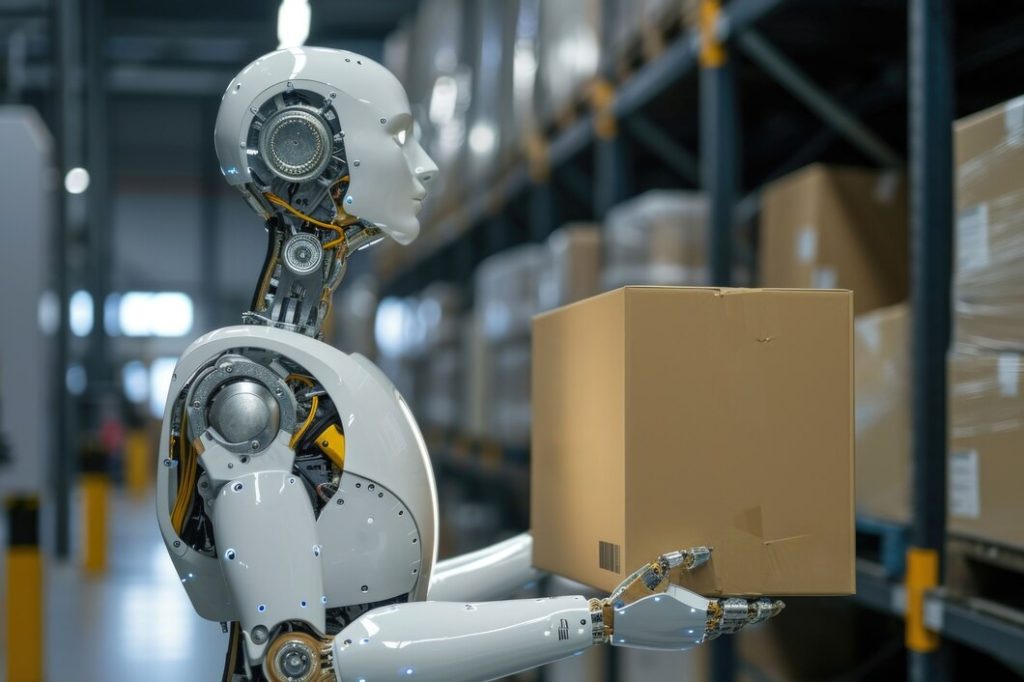
There are several advantages to using these automated systems. They assist in various aspects of organizations.
The automatic palletizers are faster than people. They can run 24/7. They do not need breaks. They can handle larger volumes of product. It increases the efficiency exponentially.
More rapid work = higher throughput. The volume of product that has undergone some kind of processing is called a throughput. Automated palletizers have a higher throughput. This accelerates production and shipping.
So automation replaces manual work. The workers needed for palletizing is reduced. This is a cost that depends on wages and benefits. Labor is one of the biggest expenses of a factory.
The accuracy of machines is superior to that of humans. The right solution comes down to the perfect load — leading to storage, shipping, and transportation efficiencies. Consistent and steady stacks. This reduces product damage. It further streamlines the organization of the warehouse.
It is challenging and dangerous to implement manual palletizing. Heavy loads will hurt you. Yes, automated systems take workers out of these jobs. Which makes the work environment safer. Safety means fewer workers hurt and lower costs, happier workers.
As production increases, automated systems can deal with increased volume. They also can be reprogrammed to grasp different products. This allows them to be both scalable and flexible. They are flexible to diverse needs and can be adjusted accordingly.
Stacked well, pallets take up less space. Before we dive in… Automated palletizers stack well. This optimizes warehouse space. More efficient space utilization lowers storage expenses.
Automated palletizers come in various forms. They are made for different needs.
These use robot arms to do the palletizing. They are quite flexible and versatile. They can accommodate complex stacking configurations. They are suitable for many product types and sizes.
These pallets load entire layers, all at once. For uniform products, they are extremely rapid. Those are used on high-speed, big-volume lines. Aside from this, they are great for cases of beverages or food.
This is for cases and cartons. They are robust and reliable. The application of those is in numerous sectors too. These are useful for general case handling.
They palletize rows of products. They are slower than layer palletizers. But they are more flexible. They can cope with items that are a little less uniform, too.
This is information intended for bags and sacks. They use specialized end effectors for bags. They differ in the categories of bags they can fit. 38 They are employed in sectors including agriculture and chemicals.
These systems operate under a specific procedure. It is a quick and automated process.
There are products fed into the system. They are conveyed to the palletizing station. Product flow is controlled and stable.
The purpose of this phase is to inspect and orient the product. Products are checked for quality. They are in the right position to be stacked. Vision systems and sensors assist with this.
It pulls the product by the robot or palletizing head. It moves it to the pallet. It puts it in the program position. This is done for every product.
The pallet is loaded layer on top of layer with products. The system oversees pallet dispensing and removal. Full pallets are moved out. Empty pallets are moved in.
Everything is monitored by the control system. It ensures smooth operation. And operators would be able to monitor the system. They're able to adjust if they need to.
These are in use across a range of industries. They are useful for any industry that must palletize their products.
They are extensively used in food and beverage factories. They take cases of beverages, food boxes, and bags of goods. They address the hygiene and speed needs of this industry.
Used in factories that make consumer goods. That other category includes household products and electronics. They have high volumes of products to palletize for retail.
Automated palletizers are used by pharmaceutical companies. They take accuracy and cleanliness. They deal with medicine cases and health care products.
Chemical facilities use them for drums and containers. They focus on safety and precision. They work with chemicals and hazardous materials.
They are used in large warehouses and distribution centers. They simplify end-of-line processes. They streamline warehouse functions and accelerate shipping.
In modern industry, Automated material handling palletizers are crucial. They become more efficient, cheaper, and safer. They’re utilized across many industries for mass production. With the improvement of technology, they have been playing a much greater role in the future of material handling and logistics. This will build competitive and efficient factories in the future. If you are looking for highly efficient Automated material handling palletizers then visit Warsonco.










 Search
 +86 18046987606
  fiona@warsonco.com