
Parallel Changes the World, Collaboration Achieves the Future.
In the fast-evolving and competitive global market, efficiency and automation are the two key differentiators for industries belonging to any sector. As a result, Robotic Systems for Palletizing & Packaging are proving to be game changers, altering the way products are handled, packaged for shipping, and displayed for shoppers. Such software solutions provide several advantages, simplifying tasks, improving efficiency, and accelerating supply chain processes.
Robotic palletizing and packaging systems refer to a variety of automated solutions used for the end-of-line processes within the manufacturing and distribution industry.
Robotic Systems for Palletizing & Packaging are designed to automatically stack the products on the pallet. These are robots that pick products, typically boxes, cases, bags, or other containers, from a conveyor or production line and accurately place them on a pallet in a set format. The process of palletizing ensures that goods are prepped for effective storage and transportation.
Packaging robots, however, are meant to handle a wider range of product packaging tasks. This can be split into primary packaging (what directly encloses the product — bagging, bottling, etc.), secondary packaging (which groups primary packages together, like case packing and carton forming), and tertiary packaging (the prep for shipping, usually palletizing). Packaging robots are multipurpose and can carry out numerous essential procedures like filling containers, sealing packages, labeling products, and quality inspection.
Automation of repetitive, physically intensive tasks is the common function of both palletizing and packaging robots. They have been designed to complete these tasks rapidly, accurately, and consistently, outperforming humans in many situations. These systems usually consist of:
Item Handling: Robots use end-of-arm tooling, also called end effectors, to grip, lift, and manipulate different types of products or packaging materials.
Orientation and placement — the ability to position an item precisely in a designated spot, on a pallet, or inside a package — requires robots to have both sophisticated sensors and clever programming.
Pre-packed systems commonly include automatic pallet dispensers, conveyors, and other equipment to manage the flow of pallets and packaging materials to keep operations running.
Vision systems and sensors can be incorporated into advanced systems to identify defects in products and packages.
Palletizing robots fall into several different categories that serve groups of needs and industries.
The most commonly used robot types for palletizing are articulated robots or joint-arm robots. The multi-jointed arms offer great flexibility and dexterity to reach around obstructions and navigate complicated palletizing patterns. They are fit for various applications and product types.
A gantry robot, also known as a Cartesian robot, has straight movements only along linear axes, providing a rectangular workspace. They are strong and stable and can handle a lot of heavy loads and large furniture. Gantry robots typically handle tasks in greater risk fields such as construction materials and metal fabrication.
Cobots can be used safely next to people in a space. Fitted with advanced sensors and safety features, cobots can sense the presence of humans around them so they can slow down or come to a stop to avoid colliding with someone. They are particularly suited for applications in smaller facilities or concerning tasks that require human involvement, as they are well-matched for human-robot collaboration.
A hybrid palletizing system is a combination of one or more different types of robots or a robot with other types of automation technologies. For instance, a gantry robot might be used for heavy lifting, and an articulated robot to stack patterns requiring fine details. Hybrid systems aim to balance performance, efficiency, and suitability to the needs of applications.
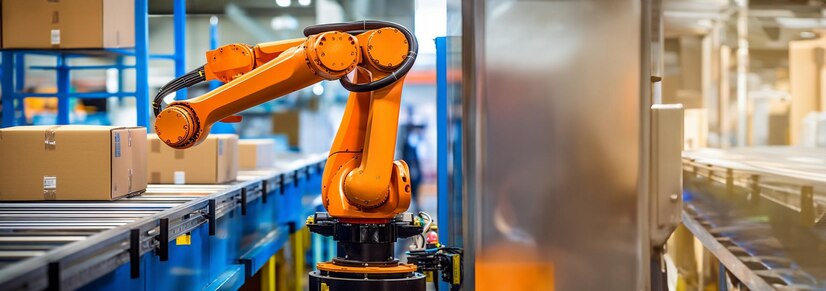
There are different types of Robotic Systems for Palletizing & Packaging available, to cater to the diverse packaging needs.
Robotic case packers load products into cases or cartons automatically. With these features, they can handle diverse case types, and major and minor case packs for secondary packaging.
Pick-and-place robots are versatile systems that can be used for a myriad of packaging tasks. They are capable of picking single items off a conveyor and transferring them to packages, trays, or other containers. They are widely used in food packaging, electronics assembly, and pharmaceutical packaging.
Depalletizing machines are the opposite of palletizing machines, as they automatically remove items from pallets. They are applied to help expedite the start of production in lines, or to assist with the fulfillment of order systems for warehouses.
The FFS systems combine many packaging functions in a single automated line. FFS systems for making packages from roll stock, filling them with products, and sealing them into packages can all be complemented with robots, a complete solution for primary packaging.
Packages can be labeled automatically and inspected for label presence, print quality, and other quality parameters using robots outfitted with labeling applicators and vision systems. This helps to maintain compliance and improves product traceability.
Robotic palletizing & packaging systems work through a combination of hardware and software components working closely with each other.
The heart of the system is where the reach and movement to manipulate products and packaging are housed.
This is the “hand” of the robot, for gripping and manipulating certain types of products. EOATs can include grippers, vacuum cups, scoops, and other types of specialized tools.
“Brain” of the robot, where the software and other programming that tells the robot when to move, what patterns to follow, and how to interact with the other components of the system is stored.
Vision systems, for example, allow the robot to "see," while force and proximity sensors enable the robot to "feel" its workload and environment, ensuring that it works accurately and safely.
Light curtains, scanners, and safety controllers play an important role in protecting human workers and preventing incidents in the robotic work cell.
The operation of a robotic palletizing or packaging system typically follows these steps:
Uses a conveyor belt to feed products into the robot’s work area.
Products that enter the system are detected and recognized by sensors. Product type and orientation may be recognized by vision systems.
The robot arm follows the controller program to pick the product using the corresponding end effector.
The device arranges the item according to requirement and positions it onto a pallet or inside a parcel to a pre-programmed arrangement.
The robot continues steps 2-4 until the pallet is completely loaded/packaged.
Palettizing/Package Outfeed: The load, whether on a pallet or in individual, packaged products, is conveyed out of the robotic work cell for further processing, storage, or shipment.
Automation of end-of-line processes is revolutionizing industries — and more than half of that transformation is being driven by Worsonco Robotic Systems for Palletizing & Packaging. Their advantages in efficiency, accuracy, safety, and flexibility are irrefutable drivers for adoption, and across a wide range of sectors.










 Search
 +86 18046987606
  fiona@warsonco.com