
Parallel Changes the World, Collaboration Achieves the Future.
Factories make many products. These goods must be stacked on pallets. This is called palletizing. It occurs at the last stop on the factory line. Special robots do this job. They’re called End-of-Line Palletizing Robots. These make work easier and speed up the production process.
Factory line — hang it up, it is the end of the line Here is where products are completed. They are prepared for packing and eventually shipped. Palletizing: the act of stacking products onto pallets. End-of-Line Palletizing Robots are the ones who do this at the end of the line. They are machines that automatically place boxes and items onto pallets. They do this job without people. That helps factories run more efficiently.
There are very good reasons factories use these robots. They make work faster. They make work cheaper. They make work safer. They are also working to make work more accurate.
These robots are very fast. They can grab boxes quickly. They can stack them fast. They do not need to rest. They can work all the time. That means factories can produce more goods. They can send products out faster.
Using robots can save money. Robots do not need wages. This means that factories require fewer individuals to handle palletizing. This saves money on labor. Robots save a considerable amount of money over time.
Palletizing is hard work. It can be dangerous. Heavy boxes are bad for workers. Robots do the heavy lifting. This creates a safer workplace. Far fewer employees get hurt performing this task.
Robots are very accurate. They create a perfect box for each position. The stacks are neat and even. This is worth doing so this was better to have it done as such by hand. People can make mistakes. Robots make fewer mistakes. It is important to stack it properly.
Several types of these robots exist. Separate tools for separate jobs. Various robots for palletizing are available for different products.
These machines are extremely adaptable. They also have these articulate arms. They can reach around things. They can arrange boxes in various ways. Articulated robots can be used for a wide range of products.
They are called gantry robots and they are incredibly powerful. They glide on rails overhead of the work area. They are capable of lifting extremely heavy objects. Gantry robots are used for heavy things. They work well with big and heavy boxes.
Cobots are designed to work in harmony with people. They are designed to be safe. They have sensors so they can avoid bumping into anything. Cobots can work side-by-side with people. They are employed in scenarios where human and robot teams collaborate.
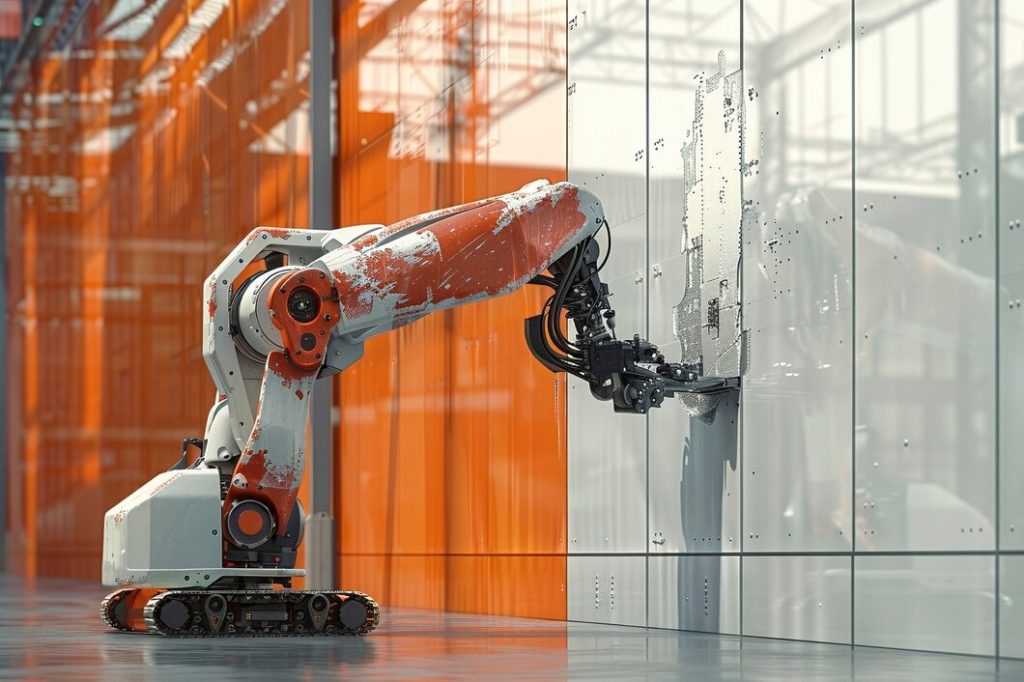
When it comes to palletizing products, these robots have a systematic process to do so. They do it step by step. It is made to be an efficient process.
Products flow to the robot on conveyors. Conveyor belts deliver boxes or items to the robot’s work area. The merchandise is prepared to be collected and palletized.
Sensors see the products. The robot’s sensors tell it where the products are. This information helps the robot know where to pick up the products. The type of product can also be identified by vision systems.
The robot arm reaches out to grab a product. It uses a special tool to capture the product. This thing is called an end effector. It may be grippers or vacuum cups.
A robot arm that picks up the product to move it to the pallet. It puts the product on the pallet. It places the product in the right spot. It operates on a pre-set algorithm. This creates a stable stack.
These steps are repeated by the robot. It picks up another product. It places it on the pallet. It keeps doing this until the pallet is full. The entire pallet is then moved away. The pallet is then wheeled into position. The robot then begins palletizing on the new pallet.
It has different components of robot systems. All parts play a crucial role. All parts work together.
The primary component is the robot arm. It does the real picking and placing of products. It is strong and precise. It is a worker in the system.
The robot's "hand" is called the end effector. It grabs the products. Depending on the product, different end effectors are used. Grippers are used for boxes. For duds, you use vacuum cups for bags.
Furthermore, conveyors for product & pallet movement. They seem to bring products to the robot. They take away full pallets. Conveyors keep products moving in flow.
Sensors and vision systems serve as the "eyes" of the robot. They assist the robot in "seeing" products and pallets. They ensure the robot operates correctly.
Controllers are the “brains” of the system. They instruct the robot about what it should do. They own every piece of the system. Controllers don’t do programs and orders.
Safety gear is supercritical. We 'bench' light curtains and scanners to keep workers safe. If anyone strays too close, they stop the robot. Safety is a top priority.
Such robots are widely used at the end of production lines in industries. They are also valuable in any industry where products are produced that need to be palletized.
Anyone who works in a food and drink factory will see these robots a lot. They palletize cases of beverages. They palletize boxes of food. They place bags of snacks on pallets. They say speed and hygiene matter in that industry.
These robots are used by factories that produce things THAT people buy. This includes clothing, electronics, and household goods. They have to palletize big volumes of products at speed.
Palletizing robots are used in medicine factories. They have to be super careful, and super clean. They located boxes of medicine and healthcare goods and palletized them. You must be precise and neat.
Chemical plants employ robotic arms. Robot arms can perform dangerous work with heavy chemicals. They palletize chemicals in drums and containers. In this industry, safety is paramount.
End-of-line palletizing robots in many factories and warehouses. This type of welding is used in general manufacturing and distribution centers. They move and stack all kinds of goods.
These robots are only going to get better.
Robots will Have AI, so they will Know More. Artificial Intelligence will enable robots to learn and evolve. With this, they will be able to take on more complex work. They will be more efficient.
Camera systems will improve. We continue our story about robots and artificial intelligence. Sensors will get better and better. In turn, this will lead to more accurate and reliable routines for robots.
There will be greater use of mobile robots. They can walk around the factory floor. It would allow palletizing products in different locations. This will add to the flexibility.
Palletizing systems will be increasingly integrated. They will interface with other factory systems. The result will be smarter and more efficient factories.
Robots and sustainability go hand in hand. They will use less energy. They will help reduce waste. Robot design will have sustainability built in.
Warsonco End-of-Line Palletizing Robots have incredible importance for advanced factories. They make production faster, cheaper, safer, and more accurate. Many industries use it. With advancements in technology, these robots will only become increasingly important. They will be critical to efficient, high-volume manufacturing in the future. These robots will make factories more competitive and profitable.










 Search
 +86 18046987606
  fiona@warsonco.com