
Parallel Changes the World, Collaboration Achieves the Future.
The factories have to get boxes and products onto pallets. This is called palletizing. It is often done by workers. But workers can get tired. And it can be slow. This job can be done faster and better with palletizing robots. Many factories are benefiting greatly from buying palletizing robots. It can increase the efficiency of how they work and save money. This article will explain why this is the case and why factories should Buy Palletizing Robots for Factories.
Palletizing robots are pieces of machinery. Each of them is engineered to verticalize products on pallets. They have a robot arm. It’s an arm that can carry boxes and other stuff. Comet use case: Picking products with a robot arm Then it sets them on a pallet. Robots can do work fast and precisely. They can lift heavy items. Palletizing robots are used to automate palletizing. This makes factories easier, and faster work.
Robots move much faster than humans. They don't get tired. They may work day and night. Palletizing robots are capable of stacking more pallets an hour. So, the ever-increasing speed of palletizing equals more production. Also, efficiency and speed are huge benefits.
Factories require fewer workers for this work. This reduces labor costs. Jobs savings can also be quite large. This increases profits because labor costs are lower.
It is tough work doing palletizing. Bending down to pick up heavy boxes can result in injuries. Robots do the heavy lifting. It makes employees feel safer in the workplace. Fewer injuries translate into lower costs and happier workers.
Robots are extremely precise. They put products in the perfect place. All pallets are stacked the same. Humans would find it hard to do this consistently. Correct and uniform palletizing increases product stability.
Palletizing is repetitive and tiresome. Robots do well in repetitive tasks. They can hoist heavy cardboard boxes all day. It frees up workers for other jobs. Robots do that hard and dull work.
They can stack pallets high. This is a more efficient use of factory floor space. More efficient use of space = More storage or production space
Both humans and robots will work together, and factories will reduce or increase robot use as per the requirement. More robots equals more production. Note that the robots can be reprogrammed for different products. One of the greatest advantages of palletizing robots is their scalability and flexibility.
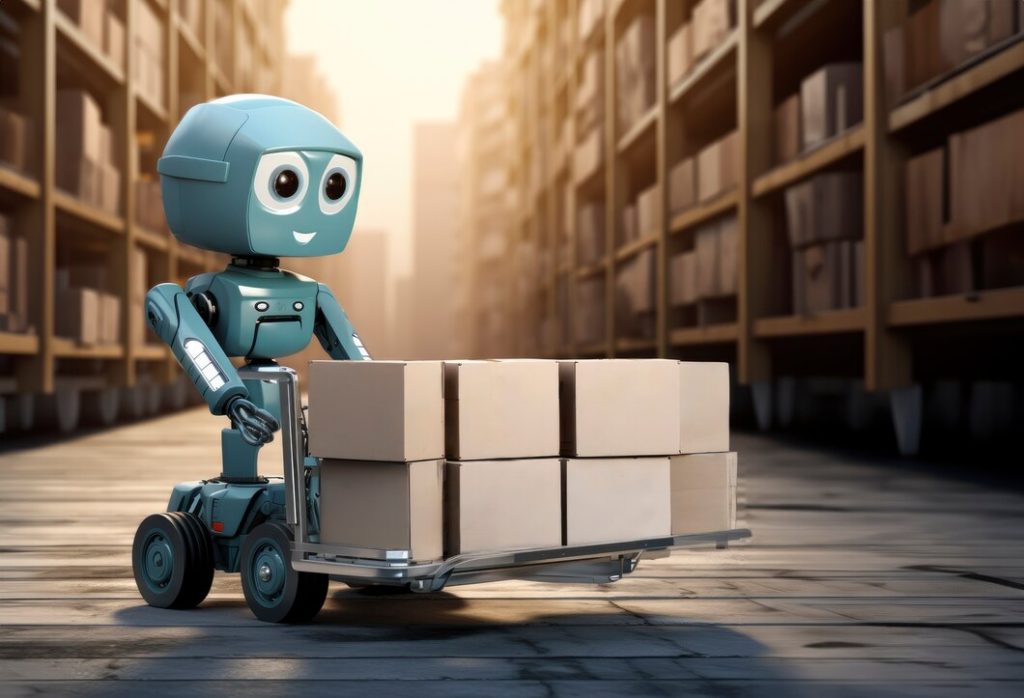
What Type of Palletizing Robots Should You Consider Buying? Palletizing robots come in multiple varieties. It should be factories, that choose the type that best suits their needs.
They are versatile and flexible Robots with jointed arms Like human arms. They can stretch in so many directions. This is why articulated robots are great for complex palletizing. Each of them can scale and adapt to various product types and patterns.
Cartesian Robots – Straightforward And Accurate. These Robots Act In A Straight Line in X, Y, and Z directions. They are extremely accurate and serve very quickly. Good for simple palletizing: Cartesian robots. These kinds are commonly utilized for boxes and cases.
SCARA Robots – Fast for Light Loads. SCARA robots come with great speed and efficiency. They work best on lighter products. Horizontal planes are where they excel. SCARA robots are well-suited for light-duty palletizing at high speed.
Cobots are built to work alongside humans without threatening them. They’re outfitted with sensors that halt them the moment someone moves too close. Cobots work well in factories where robots and humans work closely together. One of the main aspects of cobots is safety.
Guide to Buying Palletizing Robots BUT first, factories must consider a few factors before purchasing palletizing robots.
What kind of products will the robot palletize and their dimensions? Boxes, bags, bottles, or what? How large and heavy are the products? The type and size of the product will determine the robot's choice.
What is the size of pallets? What stacking pattern do we need? The robot must have the reach and software to meet the pallet and pattern needs.
How many pallets must be stacked per hour? How quickly does the robot need to operate? Production demands must be met with the robot’s speed and cycle time.
How much space do you have for the robot system? Is the robot going to fit into the factory process? There may be size and layout options for the robot to fit into.
How much can the factory afford to spend on a robot system? How long until all that money is saved up rather than wasted? Costs Essentials including ROI are significant financial factors.
How easy is it to use and program? Does the factory have personnel who can operate and maintain the robot? It helps a lot for the tool to be user-friendly and well-supported.
Cost of Palletizing Robots Palletizing robots are not free. Depends on the robot system type and size, but can be expensive.
The Capex includes the robot, a gripper, safety equipment, and installation. Prices can vary from $50,000 to $200,000 or more. More complicated systems are more expensive.
Robots need energy to operate. They might need a little TLC. Generally, operating costs are less than labor costs. Robots ultimately save money.
Why get an ROI from Robots? Robots reduce labor & increase efficiency It focuses on ROI or return on investment time. Palletizing robots typically provide a strong ROI. The initial cost is almost instantly made up in savings.
Palletizing Robots Installation and Integration There is no single solution that would be appropriate for all industrial automation scenarios; hence we need to plan for palletizing robot system setup.
Carefully plan the robot layout and integration. Acknowledge product flow and safety. With proper planning, a smooth installation is guaranteed.
Robot Specialists will install the robot. They will configure the robotic arm and end effector. As a result, installation generally takes a handful of days.
The software for the robot will have to be interfaced with the factory software. This means whoever has to program the robot to do the right pallet patterns. The robot software setup is the basis upon which the robot operates.
Training and Testing First, the Factory Employees require training on how to use the robot. Testing is what guarantees the robot is functioning properly and safely. Training and testing your organization for success
Palletizing Robots (Maintenance and Support) Well-maintained robots work better, just like any other machine.
Robotics requires frequent checks and maintenance. Greasing, cleaning, and proper inspections. Maintaining the robot regularly will help prevent these problems and increase the life of the robot.
Vendors provide technical support. They can assist with issues and fixes. Well, support means fast fixes, if things go wrong.
Factories must ensure spare parts are available. Fast access to spare parts reduces downtime. A steady supply of parts is crucial.
Palletizing robots is a saving investment for factories. Robotics makes processes more efficient, cuts costs, and protects workers. There are a lot of benefits to them for modern manufacturing. One needs to pick the right robot and plan well. Palletizing robots are a boon for any factory trying to automate and scale, but the benefits don't stop there. Buy Palletizing Robots for Factories from Warsonco to cut down costs and enhance the efficiency of your factory today.










 Search
 +86 18046987606
  fiona@warsonco.com